
“Break the illusion. Build the company.”
— The Tenacious Founder
"THE SYSTEM"
Survive Chaos.
Scale with Purpose.
Win on Maturity.
- The System helps you survive startup chaos, become a real company, then mature and scale with intention.
- Already launched? It shows exactly where you are on the maturity and capability curve — and what it takes to level up.
- Startups and companies aren’t the same. They need different tools, skills, and leadership.
- The System delivers the essentials for every Level — no fluff, just what you absolutely, positively must have.
- Looking for a quick fix or “3 shortcuts to success”? Try the Lotto. When you’re ready to build a serious business using the best methods — come back.
- Over 5 million startups launch every year. 90% fail — not from bad ideas or lazy founders, but because they realized too late:
Crafting a product and building a company are not the same thing. You have to do both.
Overview - The System Curriculum
The System is your startup to mature-company sequenced program that teaches you how to build a business by building YOUR business.
It’s like going from first grade to college in three years — but instead of a diploma, you graduate with a company that is a formidable business competitor.
This isn’t coursework you apply after the fact — it’s how you build and run your business each day. Your “grade” is your performance.
The System navigates through three entirely different worlds most founders unknowingly travel through — without a map:
TheThree Worlds
| Mode | What's Happening | What You Need |
|---|---|---|
| Ideation | Creativity thrives, but chaos reigns | Market, team, validation |
| Startup | Traction begins — survival is the mission | MVP, real product, launch |
| Company | People, process, and scale take over | MVC, delegation, rhythm |
MVP = minimum viable product - MVC = minimum viable company | ||
These aren’t just business phases — they are different founder modes-of-being. Each one demands new founder habits, new leadership methods, and new tools.
Maturity is defined by 5 sequential Levels — adapted from the Capability Maturity Model — where each stage builds on the one before it.
Think of it like grade school: you don’t skip algebra and expect to pass calculus. Each level upgrades how your company handles change, surprise, and scale — from reactive chaos to proactive consistent control.
As your company matures, so does its relationship with change. At Level 1, chaos owns you. At Level 5, you own change — and use it to win. The visual below shows how those shifts play out across the five levels
How Organizations Evolve: From Chaos to Competitive Advantage
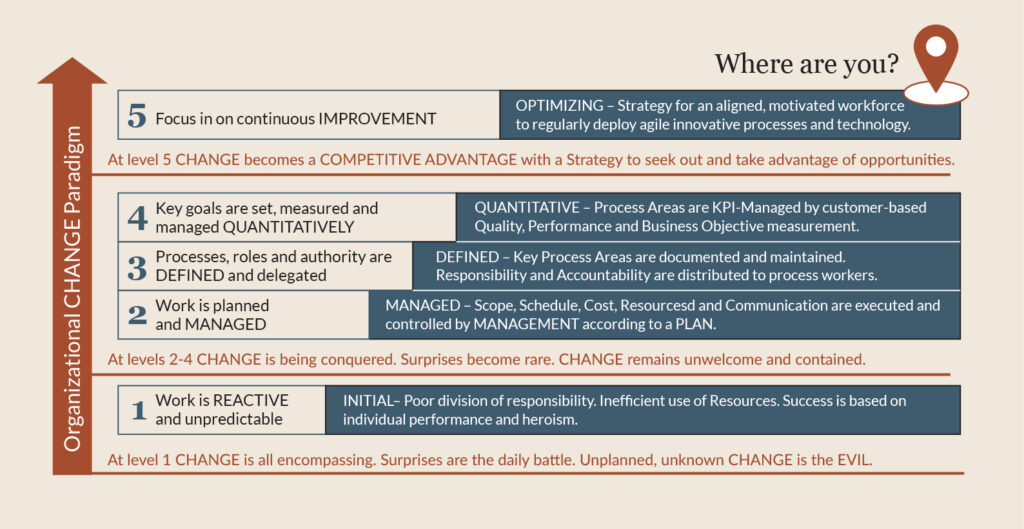
Adapted from CMMI, this model shows how your company’s relationship with change evolves across maturity levels — from firefighting chaos to system-led improvement.
Surprise is a symptom of immaturity. The earlier your level, the more you’re reacting. The higher your level, the more you shape change — instead of being shaped by it...
Level 1 introduces 12 core Success Dimensions, adapted from the Bell-Mason Diagnostic to fit the realities of startups. At Level 2, the startup graduates into a company — and the focus shifts to tools, training, and sequenced best practices used by history’s most successful businesses.
The 12 Core Success Dimensions for Startups
These are the foundations of startup and business maturity — not just a VC checklist. They form the backbone of your business plan, pitch deck, operating system, and capability.
If you’re not improving across these, you’re not building a business — you’re just burning resources.
| # | Dimension | Description (as presented in your pitch deck) |
|---|---|---|
| 1 | Market Opportunity* | The SIZE of the market (TAM, SAM & SOM) you are going after and the LEADERSHIP’s ABILITY to get it - IS IT WORTH IT? |
| 2 | Competitive Advantage* | How your PRODUCT stacks up against alternatives, and the unique Edge your TEAM has to be successful - CAN YOU DO IT? |
| 3 | Team & Leadership | The experience, expertise and skills of your TEAM. Their stake, contribution and needs. Who is running the show and what it will COST. |
| 4 | Vision | The PROBLEM, your INSIGHT to solve it — and why it matters. |
| 5 | Technical Feasibility | Can it actually be built and sustained at scale? |
| 6 | Product Development | Your process for building, testing, and refining the solution. |
| 7 | User Validation | Real evidence that real users care, engage, and benefit. |
| 8 | Product-Market Fit | Proof that customers actually want and will pay for it? |
| 9 | Go-to-Market Strategy | How you’ll find, win, and retain customers — repeatably. |
| 10 | Revenue Model | How money flows — pricing, margins, volume, and recurring logic. |
| 11 | Financials & Funding | Runway, burn rate, revenue projections and funding needs. |
| 12 | Risks & Scalability | Can you spot threats early, stay in control, and adapt without breaking? |
Funding Tip: If you don’t win investors with your Market Opportunity and Competitive Advantage, they won’t stick around for the rest.
Graduation: Startup → Company
Once you’ve nailed the 12 Success Dimensions and matured them across the Four “Bell-Mason Diagnostic” Stages, your startup graduates into a real company.
BMD Four Startup Stages:
Concept → Seed → Product Development → Market Development
Startup → Company - The Complete Journey Map
Where you are — and what’s next. Where did momentum stall? Where did outputs stop appearing without rescue?
The Complete Journey Map
| Level | Level / Stage | Primary Focus | Key Transitions | Avg Duration | |
|---|---|---|---|---|---|
| 1.1 | Initial / Concept | Raw idea, 1st pitch deck |  | Gate 1: Go/No-Go | 1-3 mos |
| 1.2 | Initial / Seed | MVP, team formation, customer validation | | Gate 2: Go/No-Go | 3-6 mos |
| 1.3 | Initial / Product Dev | Build real product, prep ops | | Gate 3: Go/No-Go | 3-6 mos |
| 1.4 | Initial / Market Dev | Launch + early traction | Transition to Company | 2-4 mos | |
| Shift from MVP to MVC | Startup → Company | ||||
| 2.0 | Managed / - | Project discipline, first KPIs, team ownership | Centralized control | 6–12 mos | |
| 3.0 | Defined / - | SOPs, dashboards, role clarity | Distributed Control & Repeatability | 9–15 mos | |
| 4.0 | Quantified / - | KPI-driven ops, risk mgmt, forecasting | Data-driven execution | 9–15 mos | |
| 5.0 | Optimized / - | Continuous improvement | Self-improving | 12+ mos | |
**Total journey: 3–5 years for serious teams.** | |||||
Anti-pattern: Skipping levels creates operational debt.
Best Practice: Build the right level of system for where you are. Not more. Not less.
Start where you are. Finish what matters. Track progress. Move forward.
Advisor / Investor Briefing
This framework isn’t just for founders. If you’re an operator, board member, coach, or investor — this is your blueprint for assessing and guiding operational maturity.
- Maps the full journey from raw startup to scaling company.
- Early stages include clear maturity gates, measurable success metrics, and role-based accountability.
- 12 Success Dimensions plot growth across startup stages — forming the backbone of the pitch deck, business plan, and ops rhythm.
- Aligns with proven risk-reduction strategies and investor checkpoints.
Once a startup reaches Level 2 (Company status), the journey shifts to operational excellence, signal-driven execution, and continuous improvement.
How to Use This as an Advisor:
Diagnose by observable artifacts.
Ask: What’s been built? What’s been delegated? Where’s the feedback loop?
Use this framework to:
- Align teams to stage-appropriate priorities
- Reduce chaos without stifling momentum
- Accelerate scalable, investable execution

End of the Overview Read More Section
Where to Start
- Identify your current maturity level
- Confirm all requirements from earlier levels are complete — they’re foundational
- Review the next level’s requirements
- The difference = your GAP — and your short-term roadmap
- Don’t skip steps. Each one builds on the last
- Growth requires discipline, learning, and capability — not just hustle

This workspace is built to scale.
Use it to build your company — or clone it to guide others.
Do the work in sequence.
Don’t chase dopamine. Build operational discipline.
Startups Begin Here — CMMI Level 1 / BMD
Level 1 Goal:
Prove the need. Get to product. Start building the company, not just the app.
Level 1 follows four early-stage startup phases adapted from the Bell-Mason Diagnostic (BMD):
Founder Behavior:
You are the system. Validate traction. Avoid hiding in busywork.
BMD Startup Stages:
Concept → Seed → Product Development → Market Development
Each Stage includes worksheets built around 12 core Success Dimensions — the critical capabilities most predictive of business survival, fundability, and eventual scale.
The Track for Existing Companies —
CMMI Levels 2–5
This is for companies that completed Level 1 and launched a real product - those that have graduated from startup to company.
Founders begin stepping back here. You stop doing — and start delegating.
This track draws from systems behind Ford, GM, TQM, IBM, Carnegie Mellon’s SEI, and the U.S. Department of Defense — refined for startup realities.
You’ll learn how to build a company that delivers consistently — on time, on budget, and as promised. The kind people trust, buy from, and invest in.
Failure Mode:
Trying to optimize chaos. You can’t jump to KPIs and dashboards before you’ve earned control and built process.
If you can’t document it, you can’t delegate it.
If you can’t delegate it, you can’t scale.
End of Where to Start Read More Section
INITIAL Startup Mode
Average duration: 9–18 months
You’re not a company — you’re a startup. Chaos is on the menu. Just don’t get stuck here — chaos eventually kills.
So You Wanna Build a Rocket Ship…
Startups are seductive — freedom, purpose, innovation… maybe a shot at changing the world.
Build something you love. Disrupt an industry. Make a boatload of money. That’s what the brochure said, right?
You got into this with a wild idea and just enough reckless optimism to think *you* could pull it off — maybe even join the “I had a successful exit” club.
-
“Entrepreneurship is the only career path where delusion is a prerequisite.”
— Anonymous
Let’s see if you can survive ignition.
Ownership Evolves with Maturity
Each Stage includes worksheets built around 12 core Success Dimensions — the critical capabilities most predictive of business survival, fundability, and eventual scale.
Founder Behavior:
Right now? You’re doing all the lifting. But that’s about to change.
You Are Here
| Level | Ownership Type | What Drives It |
|---|---|---|
| 1 | Founder-Centric | Vision + Hustle |
| 2 | Project-Centered | Functional & Project Managers |
| 3 | Process-Centered | Department Leads |
| 4 | Signal-Centered | KPI & BOS Owners |
| 5 | System-Centered | Cross-Function Leaders |
Maturity = Climbing out of Level 1 by leveling up the 12 Success Dimensions through Four Stages of Startup Growth
The Beginning
Don’t skip ahead. The foundation you build here determines the strength of everything that follows.
This is a chain. It is only as strong as its weakest link.
You begin the strongest early-stage framework we know — the Bell-Mason Diagnostic (BMD), embedded within CMMI Level 1
It’s battle-tested by VCs, the U.S. Department of Defense, and elite operators who know how to separate signal from noise.
Level 1 exists to turn creative fire and elemental chaos into operational traction — through systems thinking, team alignment, and ruthless execution discipline.
Earning Level 1 - Your Checklist
You’ve earned Level 1 when you’ve proven there’s a real problem — and started solving it in the real world.
- You’ve built a real product — and put it in real customer hands
- You’re getting feedback — from actual usage, not just opinions
- You’re seeing traction — engagement, retention, or conversion is happening
- You’re still the system — the founder is directing everything
- No real infrastructure yet — no org chart, KPIs, or operating rhythm (that’s next)
The goal here isn’t polish — it’s proof.
You’re validating reality, not fantasizing about scale.
Most startups stall here by endlessly tweaking the product or chasing funding before signal exists.
You graduate from Level 1 by building the company — not just a clever tool.
Level 1 Stages
1.1 CONCEPT Stage - The Start (1-3 months)
Capture the idea, define the problem, shape the vision
Go/No-Go Gate 1
1.2 SEED Stage - Build the MVP (3-6 months)
Form the team, build the minimum viable product (MVP), validate early traction
Go/No-Go Gate 2
1.3 PRODUCT DEVELOPMENT Stage - Build the Production Version (3-6 months)
Stand up the real product, tighten delivery systems, prep for launch
Go/No-Go Gate 3
1.4 MARKET DEVELOPMENT Stage - Launch (2-4 months)
Go live, track adoption, prove revenue
CHAOS WARNING: In the early days, chaos is part of the job — and it even feels good. Everyone’s moving fast, breaking things, and chasing shiny objects like caffeinated raccoons.
It’s exciting. It’s exhausting. It’s necessary.
But don’t confuse motion with progress.
Complete ALL the Stages, Success Dimensions and pass the Gates. Move to Level 2 as fast as reasonably possible — or shut it down.
Stay here too long, and it’s fatal.
End of the Level 1 Read More Section
MANAGED PROJECTS Startup → Company
Average duration: 6–12 months
(if Level 1 is complete and leadership stays engaged + coachable)
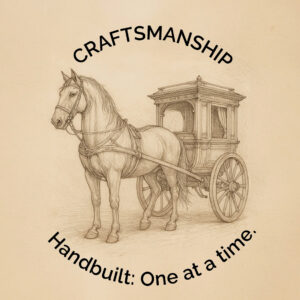
You’ve launched your product. Now you have to learn to run the business behind it. For 2.6 million years, craftsmanship was the pinnacle of industrialization. That’s where you are — just using modern tools.
Welcome to the Big Leagues
Congrats — you made it past chaos…mostly.
You’ve shipped product, survived, and crossed the line from *startup* to *company*. Up until now, nearly all your energy went into the product — from concept to MVP to launch. Along the way, you built just enough “company” to get that done.
That puts you ahead of 70% of startups who never get this far.
You’re no longer a startup. You’re a company — but you’re not yet scalable.
Now the focus shifts — from building a product to building the business.
Maturity Evolution
You Are Here
| Level | Ownership Type | What Drives It |
|---|---|---|
| 1 | Founder-Centric | Vision + Hustle |
| 2 | Project-Centered | Functional & Project Managers |
| 3 | Process-Centered | Department Leads |
| 4 | Signal-Centered | KPI & BOS Owners |
| 5 | System-Centered | Cross-Function Leaders |
Maturity = distributing power without losing clarity.
From MVP to MVC
You built a Minimum Viable Product, now build your Minimum Viable Company.
That means:
- Running structured projects with real scope, budgets, and timelines
- Assigning ownership by role, not personality
- Embedding KPIs into daily execution
- Establishing rhythm, feedback loops, and accountability
Level 2 is about centralized control, coordinated execution, and operational credibility.
How Long Does It Take to Master This Level?
| Level | Average Duration | Focus |
|---|---|---|
| Level 1 | 9-18 months | Cultural wiring + Build Product → Launch |
| Level 2 | 6-12 months | Project discipline. + Distributing Tasks |
| Level 3 | 9-15 months | Project → Process + Distributing Authority |
| Level 4 | 9-15 months | KPI-driven systems and team alignment |
| Level 5 | 12+. months | Continuous optimization + market-level improvement |
When it takes longer:
- Founders won’t delegate
- Teams resist visibility/accountability
- PM methods & tools are skipped or misused
- Level 1 gaps persist
When it’s faster:
- Chaos pain creates hunger for structure
- Training is complete and applied
- Tools fit and are embedded
- Projects are how real work gets done
You can't rush maturity. But once the pain is real, momentum builds fast.
Culture Shift: From Founder-Centric to Team-Driven
This stage isn’t just about tools and dashboards — it’s about leadership evolution.
- Decisions are made by function owners, not just the founder
- Managers lead objectives, not just check off tasks
- Success is shared, not siloed
- Every role owns a result
You’re not just adding headcount. You’re building a system that can think, act, and scale — without you in every room.
Earning Level 2 - Your Checklist
You’ve earned Level 2 when project execution is the default mode of operation.
- Structured projects are led by key team members.
- Project management training is complete — and visible in action.
- KPIs emerge from projects — and drive weekly decisions.
- Rhythm exists — with regular reviews, meetings, and checkpoints.
- Scope, schedules, budgets, and accountability are tracked and enforced.
This isn’t paperwork. It’s muscle memory.
Level 2 builds the shared language and tools of scale – without it, everyone is speaking Babel.
SHORTCUT WARNING: Skip or downplay project management, and your “company” becomes a slow-motion train wreck:** bloated headcount, missed deadlines, burned cash — and nobody accountable.
Here’s the truth:
60–80% of managers don’t actually know how to manage.
(PMI, HBR, McKinsey+)
They’ve never been trained in the fundamentals:
Scope. Schedule. Budget. Quality. Risk. Communication. Resources. Stakeholders.
These aren’t just “project skills” — they’re business skills.
They are the **core execution disciplines** every manager must know.
They’re neither optional – Nor intuitive.
If your managers can’t run a project, they can’t run the business!
Skip Level 2, and you’re not scaling a company — you’re scaling chaos.
You’ve launched your product. Now prove you can run the business behind it.
Success Dimensions: From Hustle → Plan the Work & Work the Plan.
2.X.1 Professional PROJECT MANAGEMENT for ALL
The foundation of how real work gets done - now to exit.
2.X.2 Managing by Numbers – Track What Matters, Ignore What Doesn't
Metrics, KPIs and dashboards - operational visibility begins.
2.X.3 Roles & Accountability – Who Owns What
Clarity of responsibility → aligned action.
2.X.4 Operational Tools – "The STACK"
From duct tape to infrastructure. Automate where it matters.
2.X.5 Financial Cadence – Budget, Forecase, Actuals, Variance
Runway, burn, forecasts - no longer optional.
2.X.6 Training for All – Lift the Team Together
Everyone grows - execution, finance and servant leadership.
2.X.7 Certifications – Optional but Strategic
Sharpen skills, signal credibility, win trust, and meet standards.
End of the Level 2 Read More Section
DEFINED PROCESS Projects → Process
Average duration: 9–15 months
(if Levels 1 & 2 are complete and project discipline + KPIs are embedded company-wide)
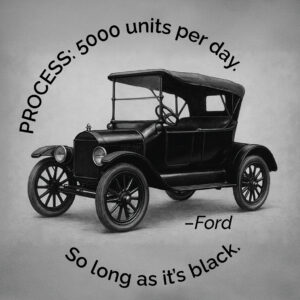
Step into Henry Ford’s shoes - put some process in place and start scaling.
The Shift: Centralized Control → Distributed Authority
You’ve crossed an evolutionary line — and entered the modern industrial world, evolving past 2.6 million years of craftsmanship.
At Level 3, you join Ford and the elite builders of modern industrial systems — creating a company that can run itself.
You’re no longer managing work through individual heroics or daily triage. You’re building repeatable systems that produce consistent outcomes — regardless of who’s at the wheel.
If you can’t document it, you can’t delegate it. If you can’t delegate it, you can’t scale it.
That means documented SOPs, clear handoffs, embedded metrics, and dashboards that drive decisions — not just decorate slide decks.
Departments own their workflows. People onboard into a playbook. Managers lead through rhythm and metrics — not micromanagement.
This is where your Minimum Viable Company starts to scale.
Maturity Evolution
You Are Here
| Level | Ownership Type | What Drives It |
|---|---|---|
| 1 | Founder-Centric | Vision + Hustle |
| 2 | Project-Centered | Functional & Project Managers |
| 3 | Process-Centered | Department Leads |
| 4 | Signal-Centered | KPI & BOS Owners |
| 5 | System-Centered | Cross-Function Leaders |
Maturity = document it, delegate it, scale it.
How Long Does It Take to Master This Level?
| Level | Average Duration | Focus |
|---|---|---|
| Level 1 | 9-18 months | Cultural wiring + Build Product → Launch |
| Level 2 | 6-12 months | Project discipline. + Distributing Tasks |
| Level 3 | 9-15 months | Project → Process + Distributing Authority |
| Level 4 | 9-15 months | KPI-driven systems and team alignment |
| Level 5 | 12+. months | Continuous optimization + market-level improvement |
When it takes longer:
- SOPs exist but aren’t followed or updated
- Process handoffs are clumsy or unclear
- Dashboards aren’t visible or useful
- Department heads don’t own their outcomes
- Teams still operate in silos
When it’s faster:
- SOPs and playbooks already in use
- KPIs are discussed — not just displayed
- Hand-offs are clean, roles are respected
- Process owners are empowered
- Continuous improvement habits are emerging
You’ve stopped reinventing the wheel. Now you’re building The System.
Culture Shift: From Founder-Centric to Team-Driven
Level 3 is where you extract tribal knowledge from Slack threads, random Notion pages, and veteran heads — and turn it into scalable operational IP.
- Project = how we did it once
- Process = how we’ll do it every time
- Standard = how we know it’s done right
Great process isn’t red tape — it’s a launch pad.
And now your operational IP doesn’t walk out the door when someone quits.
Earning Level 3 - Your Checklist
You’ve earned Level 3 when process runs the business — not personality.
- Core processes are documented, owned, and followed
- SOPs, templates, and playbooks are embedded in daily work
- KPIs are tied to processes — and tracked in meetings.
- Roles and handoffs are clear — departments run independently.
- Org chart is stable, and authority is distributed.
- Dashboards and meeting rhythms run without the founder.
This isn’t about compliance. It’s about consistency at scale.
FOUNDER WARNING: Many startups who “make it” stall here.
Founders often can’t let go — so they become the bottleneck. If you can’t shift from doer to system-builder, from control to culture…
You won’t scale. You’ll just spiral.
Level 3 proves you can deliver results — without reinventing how, every time.
Success Dimensions: From Project-Based Success to Process-Powered Scale.
3.X.1 PROCESS Architecture – From Project to Process for All
Map how value is created - then make it transferable and repeatable.
3.X.2 SOPs & Templates – Make It Easy to Do It Right
Equip your team with tools to win the same the same way every time.
3.X.3 Roles & Accountability – Who Owns What – It's Changing
Ownership shifts to teams. Managers lead through metrics, not micromanagement.
3.X.4 Operational Tools – "The STACK" Updated
Level 1 used a wheelbarrow. Level 3 needs a fleet.
3.X.5 Financial Cadence – Budget, Forecase, Actuals, Variance
Every team now owns numbers. Budgeting goes beyond the C-suite.
3.X.6 Training for All – Lift the Team Together
Managers fly on instruments. Everyone levels up.
3.X.7 Certifications – Sharpen Skills. Signal Maturity. Win Trust.
Earn credentials that build muscle and unlock markets.
3.X.8 Governance, Risk, and Compliance – Optional but Strategic
Build trust. Reduce chaos. Scale with confidence.
End of the Level 3 Read More Section

QUANTIFIED PROCESS Measured Process
Welcome to world-class — the mindset that leapfrogged Ford and still powers Apple. Quantify everything — from factory floor to customer desire.
Level 3 defined how work gets done.
Level 4 measures how well — and uses that data to drive decisions.
Metrics don’t just exist — they trigger action.
Data doesn’t just report — it directs.
You shift from gut calls… to dashboards.
From reaction… to rhythm.
From tasks… to levers.
By the numbers…
Maturity Evolution
You Are Here
| Level | Ownership Type | What Drives It |
|---|---|---|
| 1 | Founder-Centric | Vision + Hustle |
| 2 | Project-Centered | Functional & Project Managers |
| 3 | Process-Centered | Department Leads |
| 4 | Signal-Centered | KPI & BOS Owners |
| 5 | System-Centered | Cross-Function Leaders |
Maturity = Everyone’s Instrument Rated – the team flies by the gauges, not gut.
How Long Does It Take to Master This Level?
| Level | Average Duration | Focus |
|---|---|---|
| Level 1 | 9-18 months | Cultural wiring + Build Product → Launch |
| Level 2 | 6-12 months | Project discipline. + Distributing Tasks |
| Level 3 | 9-15 months | Project → Process + Distributing Authority |
| Level 4 | 9-15 months | KPI-driven systems and team alignment |
| Level 5 | 12+. months | Continuous optimization + market-level improvement |
When it takes longer:
- KPI tracking is partial or siloed — not adopted org-wide
- BOS is a checklist, not a heartbeat
- Scoreboards exist but aren’t used for decisions
- Department heads dodge visibility or financial accountability
- GRC/certification efforts are layered on too early
- Founders are still “rescuing” teams instead of enabling them
When it’s faster:
- KPIs are built into daily and weekly decisions
- Teams self-correct using metrics, not managers
- Your BOS (EOS, GGOB, or custom) is embraced, not endured
- Financial transparency builds engagement, not fear
- Teams are proud of hitting numbers — and know how to fix them
- GRC, compliance, and forecasts enhance execution, not distract from it
Level 4 is your organizational reality check. Systems either become the backbone — or expose your gaps.
Culture Shift: From Output to Outcome
Level 3 Defined what to do.
Level 4 Quantifies if it’s working — and how to improve it.
- You stop managing effort
- You start managing effect
- Teams see impact in real time — and optimize
Level 3 documented your playbook.
Level 4 upgrades it weekly — based on live signal.
Earning Level 4 – Your Checklist
The goal isn’t just to measure — it’s to run the business on signal.
You’ve earned Level 4 when anyone can glance at the dashboards and know where the company stands — and how their work drives outcomes.
- Every key process has KPIs — not just outcomes, but inputs and throughput
- Scorecards & Scoreboards highlight the 5–15 most critical forward-looking indicators
- Dashboards are live, reviewed weekly, and used to steer
- KPIs are embedded in SOPs — visible, owned, and acted on
- Performance reviews tie directly to Rocks and numbers, not opinion
- Variance tracking is routine — Forecast vs. Actual is routine
- Root Cause Analysis (RCA) replaces blame and bandaids
- Leading indicators prompt action before drift becomes damage
- Trendlines shape plans across marketing, product, and ops
- Teams self-correct based on data — no heroics, no waiting
- Your BOS is embraced, not endured — the heartbeat of execution
- Everyone knows how their work connects — and how to fix what’s off
In short: You’ve gone from tracking tasks → to managing levers → to tuning the machine → to owning performance.
The company runs on data — not intuition.
Everyone. Same page. Same time. Same goals.
Process Owners / Department Managers Warning:
Remember what we learned at Level 2:
60–80% of managers don’t actually know how to manage.
(PMI, HBR, McKinsey+)
Why? They’ve never been trained in the fundamentals:
Scope. Schedule. Budget. Quality. Risk. Communication. Resources. Stakeholders.
→ These aren’t just project skills — they’re business skills.
They are the **core disciplines of execution.** And now, you’re asking managers to run their departments like businesses.
If you don’t train them to do it right — they won’t.
Fix this, or:
C-Suite will be making decisions based on data that managers pulled out of their…gut.
Complete the Success Dimensions to move from Process to Signal.
You’ve built the machine. Now tune it, support it and step on the throttle.
4.X.1 Measurement, KPIs & Data – QUANTIFIED Signal for ALL
Every process must output meaningful data. If you can’t track it, you can’t manage it.
4.X.2 Business Operating Systems – Everyone, Same Page, Same Time, Same Goals
Every great business has a great system. Build your own — or implement one that works.
4.X.3 Roles & Accountability – Who Owns the Whole?
As silos grow, shared accountability ensures nothing slips through the cracks.
4.X.4 Operational Tools – Upgrade "The STACK"
Your tools must now enforce process, capture data, and guide decisions - not just tasks.
4.X.5 Operational Cadence – Plan, Do, Check, Act
Weekly, monthly, quarterly — the heartbeat of signal-based execution.
4.X.6 Training for All – Turn Process into Capability
Untrained people can’t deliver trained-process results. Teach the system to everyone.
4.X.7 Certifications – Prove it Inside and Out
Competence, consistency, credibility — and the keys to new markets.
4.X.8 Governance, Risk, and Compliance – Trust at Scale
Build resilience, reduce chaos, and signal enterprise readiness.
End of the Level 4 Read More Section
OPTIMIZED PROCESS Continuous Improvement
Average duration: 12 months to forever — this is where you live now.
(Assuming prior levels are complete, a BOS is embraced company-wide, and GRC/compliance is operational.)
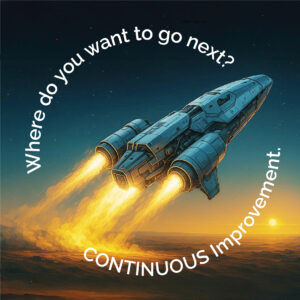
You’ve reached the end of the runway. Now you fly.
You stabilized the system. You scaled it. You made it measurable.Now what?Now, you evolve it — intentionally. Systematically. Endlessly.
Level 5 isn’t a finish line. It’s liftoff.
This is the mindset of elite operators — not always the biggest, but always the most self-improving:
- They optimize for ROI, not vanity. (Fountains and flags smell of death.)
- They double down on winners — and kill what’s outdated.
- They extend improvements across markets, not just internally.
- They educate customers, partners, vendors — not just staff.
- They renew systems and leadership on cadence — not in crisis.
In nature and business:
Stability is decay.
Growth and adaptation is survival — and your edge.
Maturity Evolution
You Are Here
| Level | Ownership Type | What Drives It |
|---|---|---|
| 1 | Founder-Centric | Vision + Hustle |
| 2 | Project-Centered | Functional & Project Managers |
| 3 | Process-Centered | Department Leads |
| 4 | Signal-Centered | KPI & BOS Owners |
| 5 | System-Centered | Cross-Function Leaders |
Maturity = Change, once the enemy, becomes your competitive advantage.
You now seek and shape new opportunities — then optimize them.
How Long Does It Take to Reach and Sustain Level 5?
| Level | Average Duration | Focus |
|---|---|---|
| Level 1 | 9-18 months | Cultural wiring + Build Product → Launch |
| Level 2 | 6-12 months | Project discipline. + Distributing Tasks |
| Level 3 | 9-15 months | Project → Process + Distributing Authority |
| Level 4 | 9-15 months | KPI-driven systems and team alignment |
| Level 5 | 12+. months | Continuous optimization + market-level improvement |
When it takes longer:
- Teams chase perfection instead of value
- Nothing gets retired — systems bloat
- Leaders confuse metrics with meaning
- The BOS stagnates instead of evolving
- “This is how we’ve always done it” wins
When it’s faster:
- Improvement is ROI-driven, not checklist-driven
- Teams improve autonomously — without being told
- Leaders coach, not dictate
- Obsolete processes are killed on sight
- Cross-functional alignment becomes reflex, not ritual
Culture Shift: From Metrics to Mastery
Levels 2–4 taught teams what good looks like.
Level 5 asks: What’s next?
- Teams ask sharper questions.
- Leaders challenge assumptions.
- Departments delete their own bad processes.
- Data becomes a lens for invention, not just inspection.
You’re not just optimizing tasks.
You’re optimizing the system itself.
Earning Level 5 – Your Checklist
- Optimization is routine — continuous improvement is built into daily rhythm
- Teams self-improve — no escalation, permission, or handholding
- KPIs are refined or retired — signal is always evolving
- The BOS evolves in sprints — not annual offsites
- Tools integrate naturally — the stack supports, not distracts
- Customer and partner feedback loops reshape your execution
- Obsolete systems are killed — no sacred cows
- GRC is embedded — trust is cultural, not compliance theater
- Cross-functional alignment is reflexive — not a special project
- The founder models clarity and restraint — not just ambition
You’re not just using a system.
You’re refining, reinventing, and expanding it.
Optimization Wheel - this is what you are doing now, all the time.
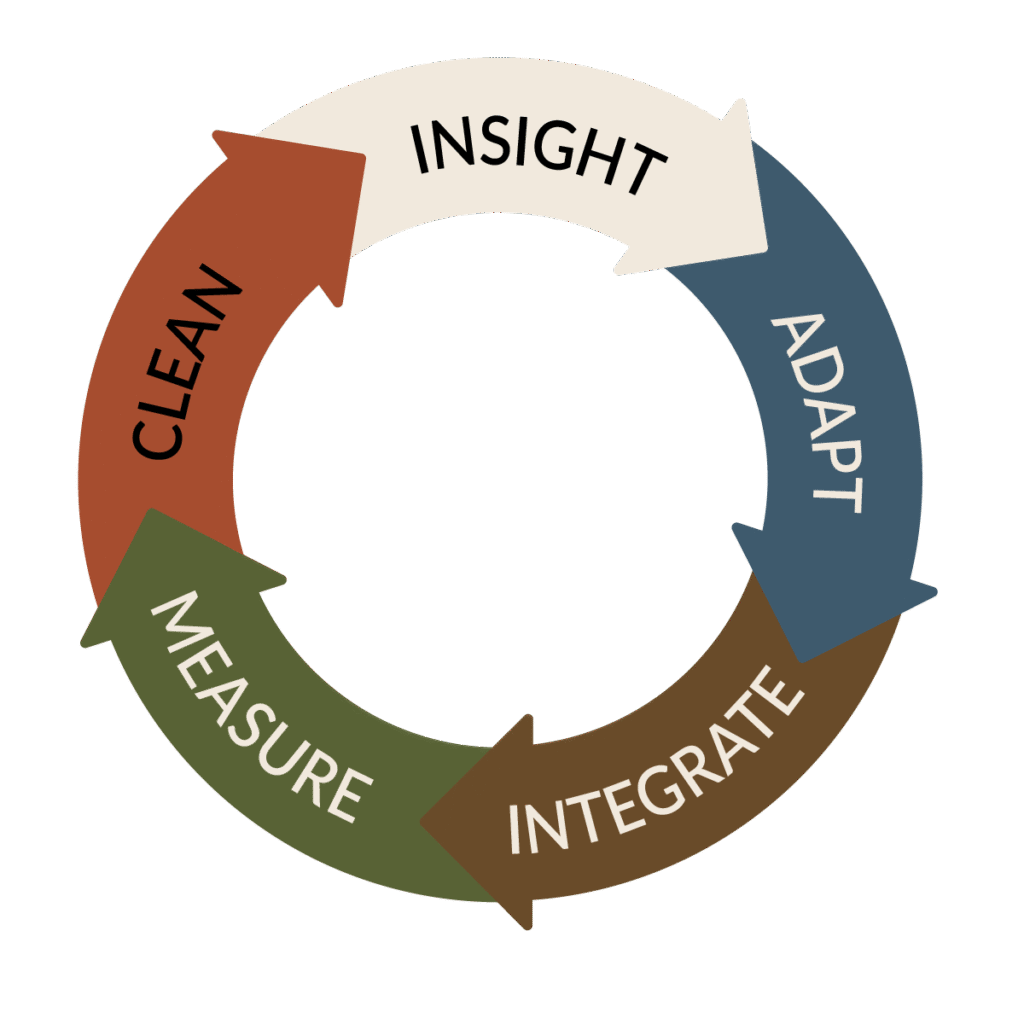
- Insight — From data, feedback, or observation (internal and external).
- Adapt — A hypothesis or tweak based on the insight.
- Integrate — Embedding that change into process, tools, or behavior.
- Measure — Tracking what impact the change actually produces.
- Clean — If it’s not working or adds complexity, kill it.
- Insight — Loop restarts, now from a better-informed position.
Level 5 = Adaptability, ROI, and Organizational Fitness
At this level, you are:
- Expanding into new markets — with clarity, not chaos
- Improving external systems — supply chains, partnerships, customer success
- Building internal capability — every team is a learning team
- Leading with restraint — knowing what *not* to do is your edge
This is where stability meets evolution
— and your company earns the right to last.
Final Reminder: The System Doesn’t Run You — It Evolves With You
“Your BOS must evolve — but never drift. The rails don’t slow you down — they keep you aimed. Strategy, purpose, and customer value stay fixed. Tactics evolve forever.”
Complete the Success Dimensions Below to Unlock Level 5 Mastery
You no longer just run a machine.
You command a ship.
Maintain it. Upgrade it. Reinvent it.
Then chart a new course.
5.X.1 Optimization for ALL – Keep on Scaling
The system is running. Now improve everything inside and outside of it — forever.
5.X.2 Strategic Cleaning – Clean House, Clear the Way
Optimization isn’t just adding capability. It’s pruning what no longer serves.
5.X.3 Roles, Accountability & Measurement Evolution – Beyond KPIs to Insight
You have the data. Now convert it into leverage, clarity, and market advantage.
5.X.4 Operational Systems Inegration – One Company, One View, One Stack
Unify your tools, processes, and signals into a single coordinated system.
5.X.5 Leadership & Cadence – Scale People, Not Just Systems
At Level 5, leaders don’t control. They cultivate, coordinate, and challenge.
5.X.6 Training Up & Down the Supply Chain – Build Smarter Markets
Teach upstream and downstream. Share knowledge to unlock new value.
5.X.7 Market Extension – Replicate, Expand, Adapt
Your system works. Where else can it win? Geography, customer segments, verticals.
5.X.8 Governance, Risk, and Compliance – Embedded, Not Bolted On
GRC is now automatic, cultural, and continuous. Trust is built into how you operate.
You’ve built the ship.
Now navigate with intent. Each Success Dimension is a lever — but the helm is yours.
End of the Level 5 Read More Section